
 Danakis Christodoulides
- GRC
- Buyer's guide
Top OneTrust Alternatives in 2026: 9 GRC Platforms Compared
Cost creep, long rollouts, ticket-only support. Here are the OneTrust alternatives worth shortlisting in 2026 — and where each one actually fits.

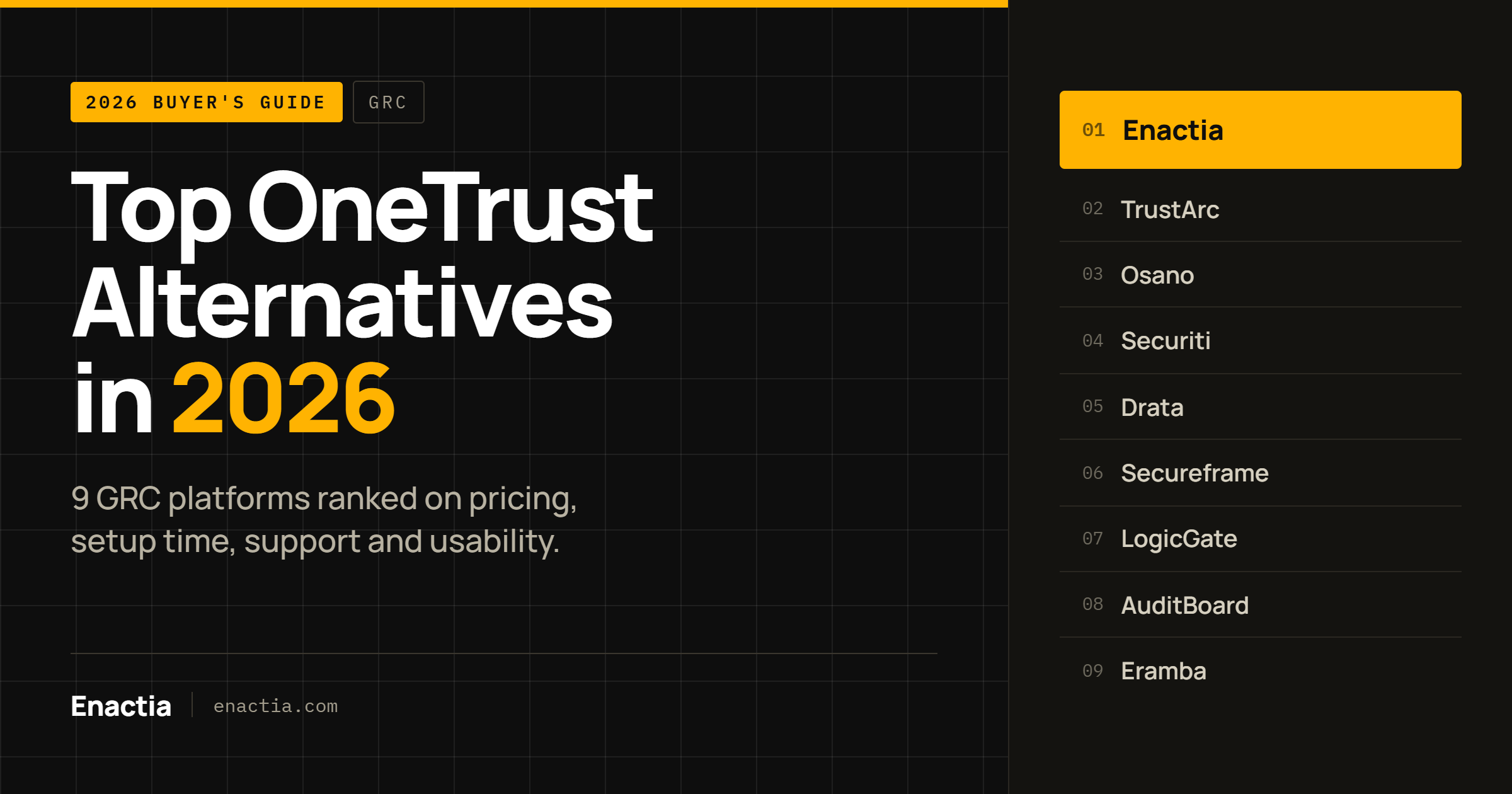
- Teams leave OneTrust over renewal cost growth, multi-quarter rollouts and ticket-only support — not missing features.
- Judge on five criteria: renewal cost, time to first value, who answers support, adoption outside compliance, cross-framework reuse.
- Privacy only → TrustArc or Osano. Security certification → Drata or Secureframe. Full GRC in one platform → Enactia.
OneTrust helped define the privacy technology category, and for very large, heavily resourced compliance programmes it remains a credible choice. But search volume for OneTrust alternatives has climbed steadily through 2026, and the reason is simple: compliance, privacy and security teams are being asked to cover more frameworks — GDPR, NIS2, DORA, the EU AI Act, ISO 42001, SOC 2, regional PDPLs — with the same headcount they had three years ago.
The complaints we hear most often in competitive deals are consistent, and they show up in public reviews too: quote-based pricing that climbs as you add modules, implementations that stretch across quarters, support that routes through tickets rather than people, and an interface that needs training before anyone outside the compliance team will touch it.
Below are the strongest OneTrust alternatives in 2026, starting with Enactia, and an honest view of who each one actually suits.
What to Evaluate Before You Choose a OneTrust Alternative
Before comparing logos, agree internally on five criteria. They predict satisfaction far better than a feature checklist does.
- Total cost at renewal, not at signature. Ask what happens when you add a module, a subsidiary or a framework in year two.
- Time to first value. Not “go-live” — the date you can show an auditor or a board a real, populated report.
- Who answers when something breaks. A named human with compliance knowledge, or a queue?
- Adoption outside the compliance team. Risk owners, IT and vendors have to use it too. If the UI needs a four-hour onboarding video, they won’t.
- Cross-framework reuse. One control, one piece of evidence, mapped to every framework that needs it. This is where the effort savings actually come from.
1. Enactia — The Best OneTrust Alternative for Agile Teams
Best for: Organisations of any size that want full GRC coverage — privacy, security, risk, vendors, policies, whistleblowing — without enterprise pricing, enterprise timelines or enterprise complexity.
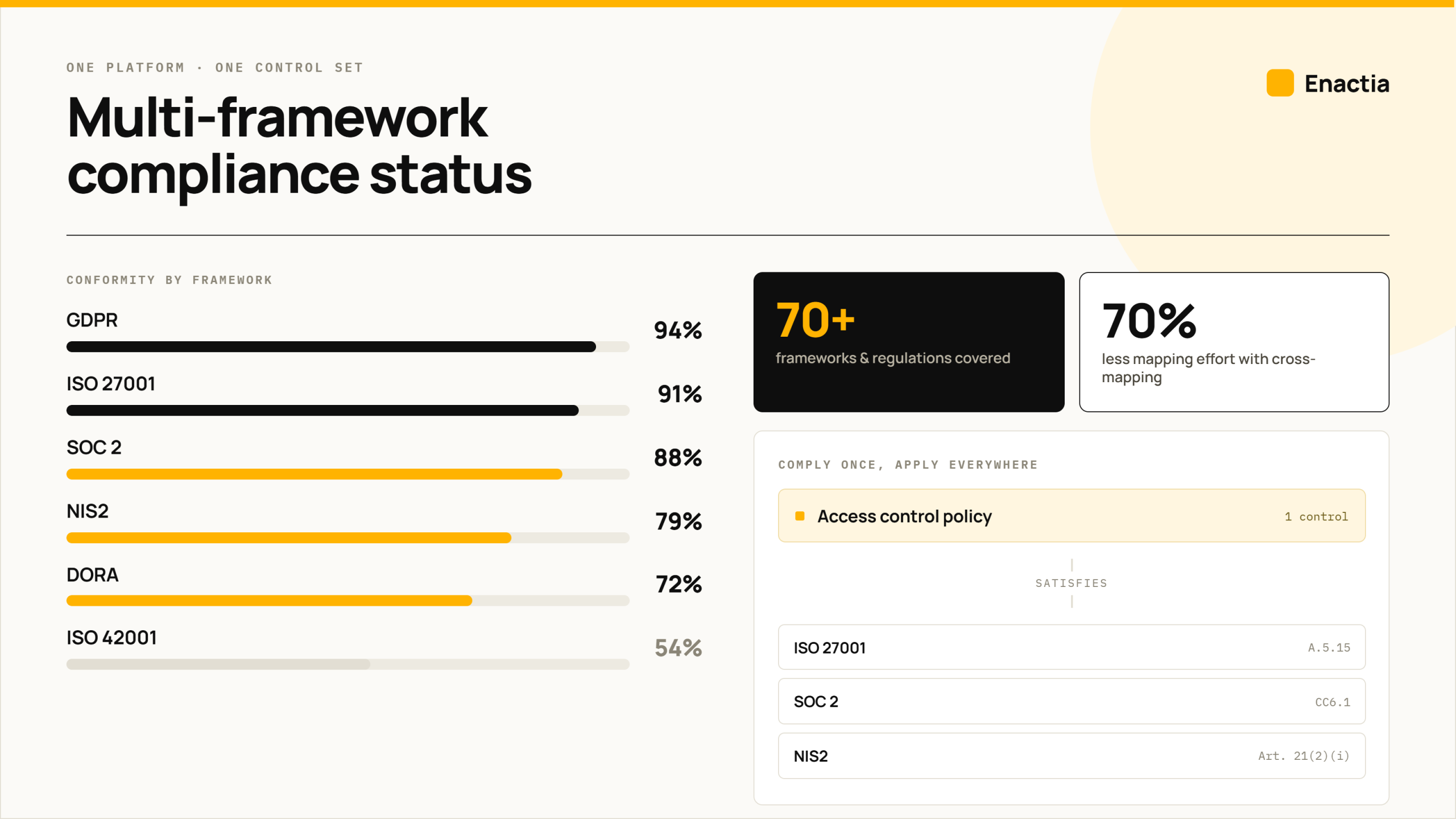
Enactia is built by working GRC practitioners rather than by a platform team, and it shows in the day-to-day mechanics. It covers 70+ frameworks and regulations, including GDPR, ISO 27001, ISO 27701, ISO 42001, SOC 2, NIST CSF, NIST Privacy, PCI-DSS, DORA, HIPAA, CCPA, and regional laws such as KSA PDPL, Bahrain PDPL, DIFC, ADGM DPR, PIPEDA, POPIA and Singapore PDPA.
Transparent, size-based pricing
Enactia prices by organisation size — Startup, Small, Medium, Large, Enterprise and On-Premise — with plans starting from tiers built for teams of up to 10 employees. Within every tier you get unlimited assessments, no record restrictions and unlimited vendor accounts, so your bill doesn’t move every time your programme grows. You can take the All-in-One package or Build Your Own and pay only for the modules you need. Annual subscriptions include two months free.
The practical difference: budgeting is predictable. There is no module-by-module escalation, no per-record ceiling, and no renewal surprise because you onboarded 40 more vendors.
Implementation in weeks, not quarters
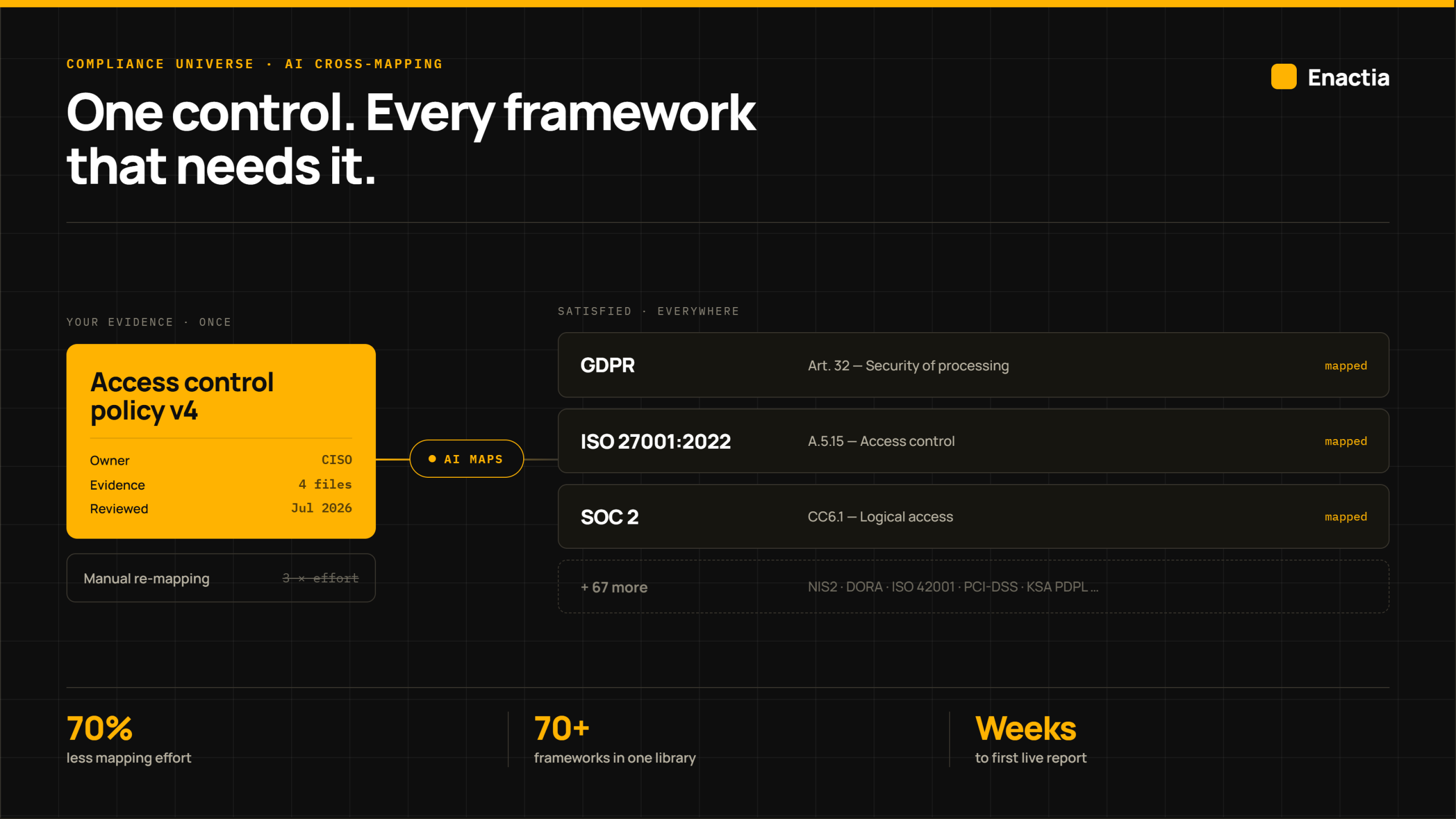
Enactia’s Compliance Universe uses AI-powered cross-mapping to link controls and evidence across frameworks automatically — comply once, apply everywhere — which the team measures at up to 70% less effort than mapping frameworks manually. Combined with pre-configured templates and an intelligent assessment builder, most organisations are running live assessments and producing reports in weeks rather than the multi-quarter rollouts typical of enterprise GRC suites. Onboarding and migration services are available if you’re moving existing ROPA, risk registers or evidence out of another platform.
Real human support
Support comes from experienced compliance professionals — no bot-first triage, no indefinite ticket queues. For teams that chose a GRC platform partly to reduce the burden on a one- or two-person compliance function, this is often the deciding factor in year two.
A UI designed for the people who actually use it
The interface was designed around real compliance scenarios: interactive dashboards, advanced multi-company global filtering for group structures and multiple jurisdictions, customisable data fields, granular role-based permissions, and dynamic reporting you can shape without a professional services engagement. A built-in action and ticketing system means remediation lives in the same place as the finding, rather than in a separate tracker.
Core modules
- Compliance Assessments
- Compliance Universe
- Policy Management
- ROPA
- DPIAs
- Enterprise Risk Management
- Vendor & Third-Party
- Incident & Data Breach
- Data Subject Requests
- Asset Management
- Ticketing & Tasks
- Document Repository
- Whistleblowing
- AI Compliance Assistant
ISO 27001 and SOC 2 certified · cloud and on-premise deployment
The Rest of the Shortlist
TrustArc
Best for: privacy-first programmes that want an established specialist
A long-standing privacy platform with strong assessment methodology and advisory heritage. TrustArc suits organisations whose scope really is privacy alone. If you also need security compliance, enterprise risk and vendor governance in one system, you’ll likely end up buying a second platform.
Osano
Best for: SMB and mid-market consent & core privacy
Osano combines cookie consent, DSAR workflows, vendor risk and data mapping in a lighter package than OneTrust, and is known for a straightforward setup. Its coverage stops short of full multi-framework GRC, so it’s a better fit for privacy-only mandates than for teams also chasing ISO 27001 or DORA.
Securiti
Best for: data-heavy discovery and AI governance
Securiti’s strength is finding and governing sensitive data at scale, with growing AI-governance capability. It is a genuine alternative if data discovery is the centre of your programme — and heavier than most teams need if it isn’t.
Drata
Best for: SaaS pursuing SOC 2 and ISO 27001 quickly
Automated evidence collection and continuous control monitoring, tightly focused on security certification. Excellent at that job; not designed to be your privacy operations platform for ROPA, DPIAs and data subject requests.
Secureframe
Best for: audit readiness on a deadline
Similar positioning to Drata — strong automation around security frameworks and audit preparation, lighter on privacy operations and enterprise risk.
LogicGate Risk Cloud
Best for: highly bespoke enterprise risk workflows
Very configurable, which is both the appeal and the cost: teams typically need internal ownership or consulting support to design, build and maintain the workflows. Powerful if you have that capacity, slow if you don’t.
AuditBoard
Best for: internal audit, SOX and connected risk
If the reason you’re leaving OneTrust is that your real centre of gravity is audit rather than privacy, AuditBoard is a strong fit. Privacy operations are not its core.
Eramba (open source)
Best for: technically capable teams with time and no budget
Open-source GRC covering risk assessments, control management and audit tracking. Realistically, it trades licence cost for engineering and maintenance effort, and lacks the automation, templates and support of a commercial platform.
OneTrust Alternatives Compared at a Glance
| Platform | Best for | Pricing model | Implementation | Scope |
|---|---|---|---|---|
| Enactia | Full GRC without enterprise overhead | Size-based tiers, all-in-one or modular | Weeks | Privacy + security + risk + vendors + policy |
| TrustArc | Privacy-only programmes | Quote-based | Months | Privacy |
| Osano | SMB consent & privacy | Tiered | Days–weeks | Privacy / consent |
| Securiti | Data discovery & AI governance | Quote-based | Months | Data + privacy |
| Drata | SOC 2 / ISO 27001 certification | Tiered | Weeks | Security compliance |
| Secureframe | Audit readiness | Tiered | Weeks | Security compliance |
| LogicGate | Custom enterprise risk workflows | Quote-based | Months | Risk / GRC |
| AuditBoard | Internal audit & SOX | Quote-based | Months | Audit / risk |
| Eramba | Budget-constrained technical teams | Open source | Varies | Core GRC |
How to Switch Without Losing a Year
- Export before you renegotiate. Pull your ROPA, risk register, vendor inventory, policies and evidence library while you still have full access.
- Map your real framework list. Not what you licensed — what you’re actually audited against in the next 18 months.
- Run a scoped pilot. One business unit, one framework, one vendor campaign. Measure time to first usable report.
- Test support during the pilot. Raise a real question and time the response.
- Migrate in the natural gap. Between audit cycles, with onboarding support from the new vendor.
Most teams underestimate step one and overestimate steps three to five. Migration is rarely the hard part; getting clean data out is.
Frequently Asked Questions
Most commonly cost growth as modules are added, long implementation timelines, support responsiveness, and an interface that limits adoption outside the compliance team. Teams covering several frameworks at once also want cross-mapping so one control satisfies many requirements instead of being re-evidenced for each.
It depends on scope. For privacy alone, TrustArc or Osano. For security certification, Drata or Secureframe. For full GRC coverage — privacy, security, risk, vendors, policies and whistleblowing — in one platform with predictable, size-based pricing, Enactia.
Yes. Plans start at a tier for organisations with up to 10 employees and scale to enterprise and on-premise deployments, with unlimited assessments, unlimited vendor accounts and no record restrictions at every level.
Yes. Advanced multi-company global filtering, role-based permissions and centralised oversight let you manage subsidiaries and regions from one place while keeping each entity’s data separated.
Weeks for most organisations, helped by AI-powered cross-mapping, pre-configured compliance templates and available onboarding and migration services for teams moving off another platform.
See the Difference for Yourself
The fastest way to judge a GRC platform isn’t a feature matrix — it’s watching your own use case run in it. Bring your framework list, your group structure and your worst reporting headache.
Related reading: Why agile teams choose Enactia over OneTrust · Enactia licensing and pricing